Artificial Intelligence is entering a new era. For years, AI tools have primarily acted as assistants that answer questions, generate text, create images or write code when prompted. While these capabilities are impressive, they still rely on humans to guide every step of the process.
AI agents represent the next stage of this evolution.
Unlike traditional chatbots, AI agents can reason about goals, break complex tasks into smaller steps, decide which tools to use, remember previous interactions and execute actions with minimal human supervision. They are designed not just to respond but to plan, act and adapt.
Imagine asking an AI to:
- Research a product.
- Compare competitors.
- Create a marketing strategy.
- Design a landing page.
- Write the advertising copy.
- Generate social media posts.
- Schedule campaigns.
- Produce a performance report.
Instead of completing one task at a time, an AI agent can coordinate these activities as part of a larger workflow.
From customer support and software development to healthcare, finance and education, AI agents are transforming how organisations automate repetitive work and support human decision-making.
In this guide, you’ll learn what AI agents are, how they work, the different types of AI agents, popular frameworks and why they are becoming one of the most important developments in artificial intelligence.
What Are AI Agents?
An AI agent is an intelligent software system that can observe information, reason about a goal, make decisions, use tools and perform actions to achieve an objective.
Unlike a basic chatbot that waits for individual prompts, an AI agent can:
- Understand a goal
- Plan multiple steps
- Select appropriate tools
- Execute actions
- Evaluate results
- Adjust its approach
- Continue until the objective is completed
For example, instead of asking:
“Write me an email.”
You could instruct an AI agent:
“Launch my new product.”
The agent could then:
- Research competitors
- Identify customer personas
- Create marketing messages
- Design advertisements
- Build email campaigns
- Generate landing page content
- Schedule social media posts
- Monitor campaign performance
This ability to coordinate multiple actions makes AI agents fundamentally different from traditional conversational AI.
Why AI Agents Are Important
AI agents extend the capabilities of large language models by combining reasoning with action.
Businesses are adopting AI agents because they can:
- Increase productivity
- Reduce repetitive manual work
- Operate continuously
- Scale workflows
- Improve response times
- Support better decision-making
- Integrate with business software
Rather than replacing employees, AI agents often function as digital teammates, handling routine work so people can focus on strategic and creative tasks.
AI Agents vs Traditional Chatbots
Although both use artificial intelligence, they serve different purposes.
| Feature | Traditional Chatbot | AI Agent |
|---|---|---|
| Answers Questions | ✅ | ✅ |
| Plans Multiple Steps | ❌ | ✅ |
| Uses External Tools | Limited | ✅ |
| Memory | Limited | ✅ |
| Goal-Oriented | ❌ | ✅ |
| Decision Making | Basic | Advanced |
| Executes Workflows | ❌ | ✅ |
| Learns from Feedback | Limited | Often Supported |
Think of it this way:
A chatbot is like an information desk.
An AI agent is like a project manager that coordinates work until the objective is complete.
How AI Agents Work
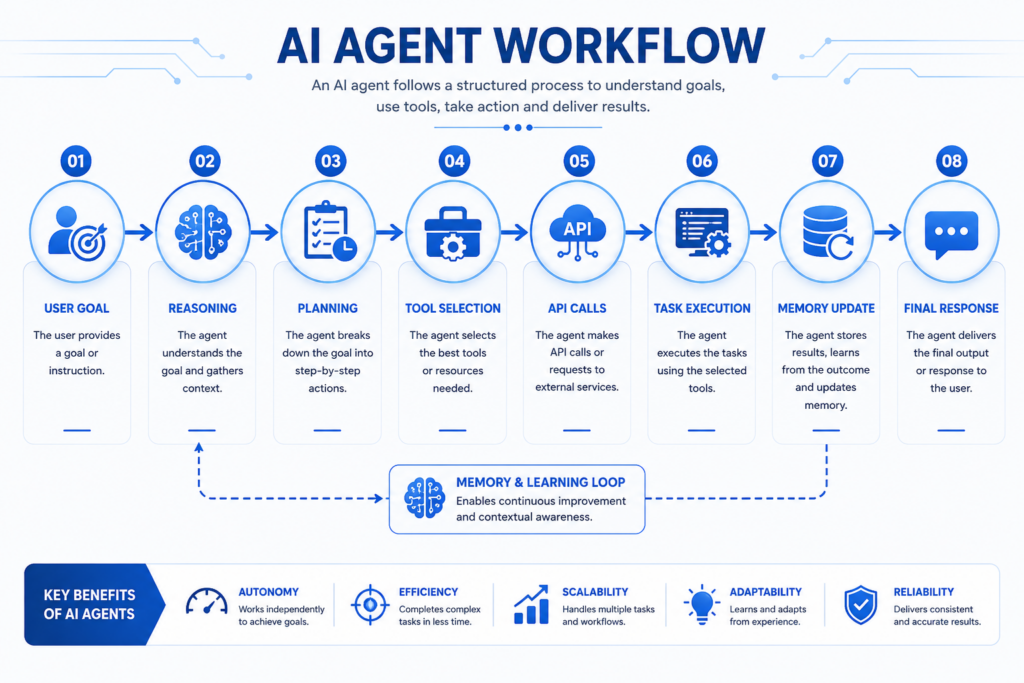
Although implementations differ, most AI agents follow a similar workflow.
Step 1 – Receive a Goal
Everything begins with a user objective.
Example:
Create a digital marketing campaign for my online store.
Unlike a chatbot, the agent treats this as a project rather than a single question.
Step 2 – Understand the Objective
The agent analyses:
- Desired outcome
- Constraints
- Available resources
- Required information
- Missing details
It builds an internal representation of the problem before taking action.
Step 3 – Create a Plan
Planning is one of the defining characteristics of modern AI agents.
For the marketing example, the plan may include:
- Research competitors.
- Analyse target customers.
- Generate marketing strategy.
- Create landing page copy.
- Write Google Ads.
- Produce social media content.
- Recommend budget allocation.
- Generate performance metrics.
Step 4 – Use Tools
AI agents often connect to external tools such as:
- Search engines
- Databases
- CRMs
- Email platforms
- Calendars
- APIs
- Document systems
- Analytics software
Instead of relying only on internal knowledge, they can retrieve relevant information and perform real-world actions.
Step 5 – Execute Tasks
After gathering information, the agent begins completing each task.
Examples include:
- Writing documents
- Sending emails
- Creating reports
- Scheduling meetings
- Updating databases
- Generating code
- Producing presentations
Step 6 – Evaluate Results
Modern AI agents don’t simply stop after generating an answer.
They review whether:
- The objective was achieved.
- Additional work is required.
- Information is missing.
- Errors occurred.
- Improvements are needed.
This feedback loop helps produce more reliable outcomes.
Core Components of an AI Agent
Most AI agents combine several specialised components.
1. Large Language Model (LLM)
The LLM acts as the reasoning engine.
It interprets instructions, generates plans and communicates naturally with users.
Examples include:
- GPT models
- Claude models
- Gemini models
- Open-source language models
2. Memory
Memory allows agents to retain useful information across tasks.
Examples include:
- User preferences
- Previous conversations
- Project history
- Completed tasks
- Long-term goals
Without memory, an AI agent would need to start from scratch every time.
3. Planning Module
Planning breaks large objectives into manageable tasks.
Instead of solving everything at once, the agent creates an organised sequence of actions.
4. Tool Integration
Modern agents interact with external services through APIs and software integrations.
Common integrations include:
- Slack
- Gmail
- GitHub
- Google Drive
- Microsoft 365
- Salesforce
- Notion
- Jira
- Databases
5. Execution Engine
The execution engine performs the planned actions.
Examples include:
- Creating files
- Calling APIs
- Running scripts
- Updating records
- Sending notifications
6. Feedback Loop
After execution, the agent evaluates its progress.
If problems are detected, it can revise the plan and continue working until the goal is achieved.
Types of AI Agents
Not all AI agents operate in the same way.
Simple Reflex Agents
These agents respond directly to predefined conditions.
Example:
“If customer asks for store hours, provide opening times.”
They are fast but limited.
Model-Based Agents
These agents maintain an internal understanding of their environment.
Instead of reacting only to immediate input, they consider previous information before making decisions.
Goal-Based Agents
Goal-based agents focus on achieving a desired outcome.
Rather than following fixed rules, they evaluate different possible actions and choose those most likely to reach the objective.
Examples include:
- Route planning
- Workflow automation
- Scheduling systems
Utility-Based Agents
These agents compare multiple solutions and select the one expected to produce the best overall result.
Typical applications include:
- Investment recommendations
- Resource allocation
- Logistics optimisation
- Dynamic pricing
Learning Agents
Learning agents continuously improve using feedback and new experiences.
They adapt over time rather than relying solely on predefined behaviour.
Examples include:
- Recommendation systems
- Fraud detection
- Personalised education
- Intelligent assistants
AI Agent Architecture
Modern AI agents combine several technologies into a single intelligent system.
A typical architecture includes:
- User Input
- Large Language Model
- Memory Layer
- Planning Module
- Tool Calling
- API Integrations
- Databases
- External Applications
- Feedback Loop
- Final Response
This modular architecture enables AI agents to perform complex workflows rather than isolated tasks.
Best AI Agent Frameworks
1. OpenAI Agents SDK
Designed for developers building AI-powered workflows.
Best For
- Enterprise applications
- Customer support
- Research assistants
- Workflow automation
2. CrewAI
CrewAI enables multiple AI agents to collaborate like members of a team.
Example:
- Research Agent
- Writer Agent
- SEO Agent
- Editor Agent
- Reviewer Agent
Together they complete complex projects more efficiently than a single agent.
Best For
- Marketing
- Content creation
- Research
- Business automation
3. LangGraph
LangGraph is designed for creating structured, stateful AI workflows.
It is particularly useful for applications that require branching logic, memory and long-running processes.
Best For
- Enterprise automation
- Customer service
- Multi-step workflows
4. AutoGen
AutoGen enables multiple AI agents to communicate with one another.
Example:
Developer Agent → Tester Agent → Reviewer Agent → Deployment Agent
This collaborative approach helps automate software development and other complex tasks.
5. LangChain
LangChain provides tools for connecting language models with external data sources, APIs and applications.
Common use cases include:
- Chatbots
- Retrieval-augmented generation (RAG)
- Knowledge assistants
- Internal search tools
Business Applications of AI Agents
Customer Support
AI agents can:
- Answer enquiries
- Process returns
- Escalate issues
- Track orders
- Personalise responses
Digital Marketing
AI agents help with:
- Keyword research
- SEO optimisation
- Campaign planning
- Social media scheduling
- Performance reporting
Software Development
Developers use AI agents to:
- Generate code
- Review pull requests
- Write documentation
- Detect bugs
- Suggest improvements
Sales
Sales teams benefit from AI agents that:
- Qualify leads
- Draft personalised emails
- Update CRM systems
- Schedule meetings
- Analyse customer interactions
Healthcare
Potential applications include:
- Administrative support
- Clinical documentation
- Appointment scheduling
- Medical research assistance
Human oversight remains essential in healthcare settings.
Education
AI agents can:
- Create lesson plans
- Personalise learning
- Generate quizzes
- Summarise study materials
- Track student progress
Finance
Financial organisations use AI agents for:
- Report generation
- Fraud detection support
- Customer service
- Risk analysis
- Compliance assistance
Benefits of AI Agents
Increased Productivity
Routine tasks can be completed faster, freeing employees to focus on higher-value work.
24/7 Availability
AI agents can continue operating outside normal business hours.
Scalability
Organisations can manage growing workloads without increasing staffing at the same rate.
Consistency
AI agents follow defined workflows, reducing variation in repetitive tasks.
Faster Decision Support
Agents can gather and organise information quickly, helping people make informed decisions.
Challenges and Limitations
Despite their capabilities, AI agents are not flawless.
Key considerations include:
- Hallucinated or incorrect outputs
- Data privacy
- Security risks
- Integration complexity
- Governance requirements
- Ongoing monitoring
- Human oversight for high-impact decisions
Successful deployments typically combine AI automation with appropriate review processes.
Future of AI Agents
The next generation of AI agents is expected to become more collaborative and capable.
Emerging trends include:
- Multi-agent collaboration
- Personal AI assistants
- Autonomous business workflows
- Robotics integration
- Scientific research acceleration
- AI-powered operating systems
- Personalised healthcare support
- Intelligent manufacturing
As the technology matures, AI agents are likely to become standard components of many digital workflows.
Frequently Asked Questions
What is an AI agent?
An AI agent is software that can plan, reason, use tools and perform actions to achieve a goal with varying degrees of autonomy.
Are AI agents the same as ChatGPT?
No. ChatGPT is an AI assistant designed primarily for conversation and task assistance, whereas AI agents are systems built to pursue goals through planning, tool use and execution.
Can AI agents access external software?
Yes. Many AI agents integrate with APIs, databases, productivity tools and business applications.
Which industries benefit most from AI agents?
Customer service, marketing, finance, healthcare, education, software development, logistics and e-commerce are among the sectors actively exploring AI agents.
Can beginners build AI agents?
Yes. Many frameworks and no-code or low-code platforms make it easier for beginners to experiment with AI agents.
Are AI agents safe?
They can improve productivity, but organisations should implement security controls, governance policies and human oversight, particularly for sensitive or high-impact tasks.
AI agents represent a significant evolution in artificial intelligence. By combining language models with planning, memory and external tools, they can automate complex workflows that previously required substantial human effort.
Whether you’re a developer building intelligent software, a business owner streamlining operations or a student exploring the future of AI, understanding how AI agents work is becoming an increasingly valuable skill.
The technology is still evolving, but one thing is clear: AI agents are likely to play an important role in how people work with software over the coming years.